
Professional Skills
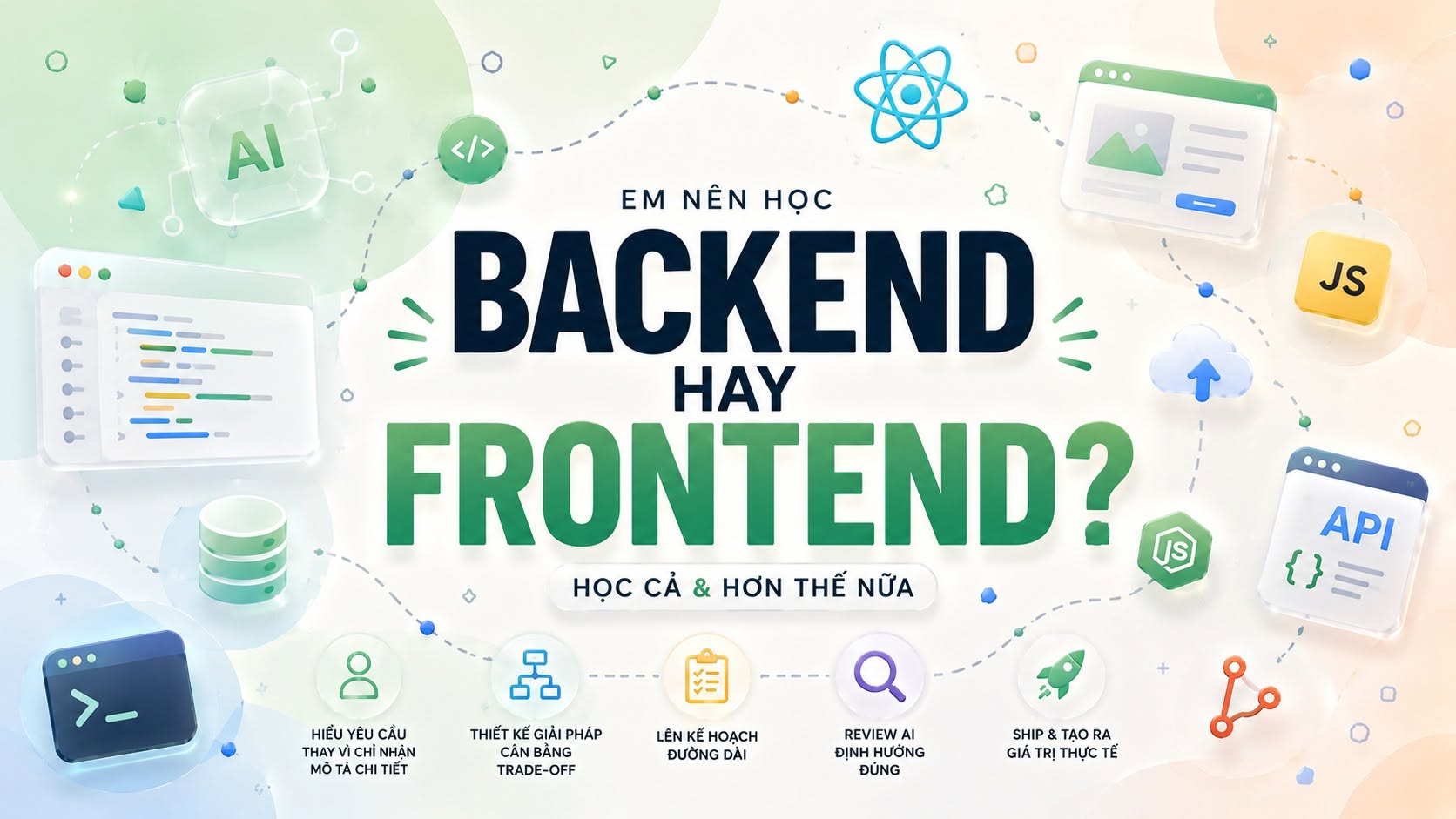
Should I learn Backend or Frontend? Learn both and more
In the AI era, newbies can no longer choose FE or BE. The value of dev translates from code to understanding problems, designing solutions and reviewing AI — with a scenario to try building and shipping a real product yourself.
22/06/2026 · 7 min read · Lê Huy Thái
"Should I learn Backend or Frontend?" — used to be a very common question among those new to the industry. But I think in this AI era, you guys don't have a choice anymore. Learn everything, and maybe need to learn more than that. Disambiguation
I. AI reduces coding time, but…
AI is developing very strongly, coding time is significantly reduced. But when teamwork, there are still unresolved things:
- Meeting to sync FE and BE, agree on API contract, return messages, validate...
- FE waits for BE to clear the logic, or fix the current API bug to continue.
- Write API documentation, review the documentation, then read each other's API documentation.
- Edited but forgot to transfer → the other guy somehow had an error the whole time.
- Etc. and so on.
II. The trend is in our own team and in many places
Therefore, if one person exploits the power of AI well - understanding operations, output, reviewing plans, reviewing code - they will go much faster than traditional teamwork between two people. Almost all of the "gap-time" issues above have been resolved.
At this time, the model will be: one dev handles a small project or a complete module. There is no longer a Backend or Frontend role.
III. So what is the value of programmers today?
If you just receive a specific request for a small task and convert it into code, then that is the job of a code engineer — something AI can do in a snap. If the developer's value only lies there, it's too easy to fade away. The story is still about making valuable contributions, doing things that benefit the company.
When a company needs a product completed, a function shipped, a problem solved — then with AI in hand, developers will need to:
- Understand the requirements, instead of just getting detailed descriptions.
- Know/find out what your boss/PM/customer wants, instead of waiting for them to say it.
- Design a suitable solution, balancing trade-off between many things.
- Plan a reasonable, long-term solution.
- Review things AI makes.
Sounds a bit like doing BA and PM work, right? Yes, but not necessarily to that extent. It's still important to bring value and solve problems. Having powerful tools in hand means greater responsibility — that's a must.
IV. Sounds too general, what specifically should a newbie do?
Specifically, I think you should:
- Learn full stack from the beginning — don't wait to be good at FE before learning BE. You don't need to be good at both right away, but you need to understand the data flow: user presses button → FE calls API → BE processes → DB saves → returns. Once you understand that flow, you'll know what you're doing wherever the code is.
- Learn to read the requirements before learning the syntax — the customer said "make the login page remember the password", do you know what to ask again? How long do you remember? On what device? How to change password? Each answer leads to a different implementation. Ask 5 minutes in advance, avoid doing it again 2 days later.
- Learn to work with AI, not compete with AI — treat AI like a junior dev: code fast but don't understand context, don't know how to trade-off, don't know what's more important. Your job is to review, guide, and know when the AI is wrong. People who don't know how to use AI will lose to those who know how to use it — but people who know how to use it but can't review it are equally dangerous.
- Learn system design at the "don't make mistakes from the beginning" level — no need to design for 1 million users. But need to know: should this data be split into tables? Does this need cache? Error at 2 am, where can I find it? These questions don't require years of experience — just the habit of asking before coding.
- Build something real and ship it out — a small do-it-yourself app from A to Z (read requirements, design DB, write API, make UI, deploy for real users) that teaches you more than 3 months of watching tutorials. Real bugs, real edge cases, real users complaining. That's learning.
If the above is still a bit general, roll up your sleeves and try this suggested scenario (getting the most out of AI at every step):
- Pick an idea that's small enough to know what you're doing, big enough to not be a weather/todo app. Be your own customer.
- Create briefs, BRDs, BA documents — review, edit, criticize if necessary.
- Choose technology — oriented according to the library/framework you want to learn.
- Phase planning — small enough to remember the entire process, name it.
- Basic system design — understanding flow is difficult, use wireframe / flow chart tools if needed.
- Divide each phase into smaller plans to understand the entire generated AI code.
- Review AI-generated code — ask if you don't understand, criticize if you find it wrong, package it into knowledge.
- Can name patterns, best practices — remember the names of prominent libraries/frameworks for each specific task.
- Leverage AI for unit testing, automation testing — and don't forget to manually test yourself.
- (Tell AI) to write project docs, update regularly - every time we shake hands, we know where we are and what we've done.
- Ship to the internet — learn deployment, domain, DNS; Rent a server yourself, buy a domain, and let someone you know use it.
- Learn basic operations — check log, status, notify when error occurs.
- Get feedback — learn how to localize, where to check, fix bugs / improve / migrate without losing old user data.